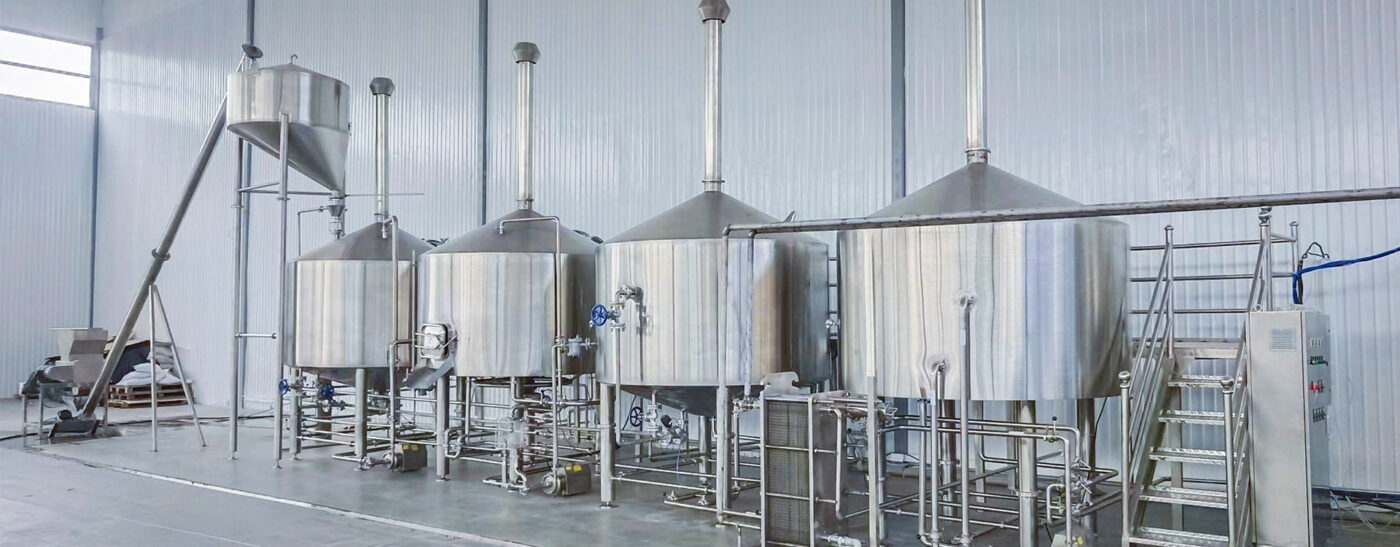
A turn-key brewery normally needs electrical power, potable and process water, heating, glycol refrigeration, compressed air, CO₂, ventilation, drainage, and CIP services sized around simultaneous production rather than vessel volume alone. Brewers Association benchmarking from 2016 found a median water-use ratio of 5.3 barrels of water per barrel of beer among 26 breweries producing 10,000–100,000 bbl/year, while median electricity use was 22.4 kWh/bbl across 28 breweries. Refrigeration capacity must also cover wort cooling, fermentation, and tank crashing. Utility sizing should therefore use actual process schedules, peak flow rates, temperatures, pressures, and simultaneous equipment demand before manufacturing begins.
A brewery’s utility schedule starts with its production plan. A 20 hL system brewing once per day does not place the same demand on the building as the same system running three turns in 24 hours. Heating may overlap with CIP, fermentation cooling may overlap with wort chilling, and packaging may consume air, CO₂, electricity, and water while another brew is underway. For comparison, the Brewers Association’s 2016 benchmarking group for 10,000–100,000 bbl/year included 28 breweries for electricity, 26 for water, 25 for natural gas, and 17 for CO₂.
That operating schedule should be converted into an equipment-by-equipment utility list before electrical panels, pipe diameters, chillers, or boilers are selected. A useful engineering schedule records connected kW, operating kW, voltage, phase, water flow, steam demand, glycol flow, compressed-air consumption, CO₂ pressure, drain flow, and expected operating hours. A 25 kW pump or heater that runs for only part of a cycle affects infrastructure differently from a refrigeration compressor operating for 12–20 hours.
Electrical demand often changes most when the heating method changes. Pumps, agitators, conveyors, control cabinets, chillers, compressors, keg washers, fillers, and cold rooms all require power, but electric kettle and hot-liquor heating can add tens or hundreds of kilowatts. The Brewers Association energy manual reports typical brewery electricity use of approximately 12–22 kWh per barrel and thermal energy of 1.3–1.5 therms per barrel in its sector profile.
| Utility | Design information needed | Common mistake |
|---|---|---|
| Electricity | Voltage, phase, Hz, connected kW, simultaneous kW, motor starting current | Adding all nameplate ratings or ignoring electric heating |
| Water | L/min or gal/min, pressure, hardness, alkalinity, chlorine, daily volume | Looking only at brewing liquor |
| Steam | kg/h or lb/h, pressure, condensate return, simultaneous users | Sizing from kettle volume alone |
| Glycol | kW refrigeration, supply/return temperature, flow, glycol concentration | Sizing only from total tank volume |
| Air | CFM or m³/min, bar/psi, air quality, peak users | Selecting from compressor motor kW |
| CO₂ | Flow, storage capacity, distribution pressure, ventilation | Treating cylinders as the complete system |
| Drainage | Peak L/min or gal/min, temperature, pH, solids | Using average daily wastewater volume |
Water sizing follows the electrical review because incoming water serves several jobs that can happen at the same time. Brewing liquor may account for the finished product, while vessel rinsing, CIP, hose stations, keg washing, packaging, floor cleaning, and water treatment create additional consumption. Brewers Association guidance notes that breweries without successful conservation programs can use more than 10 gallons of water for each gallon of beer produced.
Benchmark data gives a more useful reference range. In the Brewers Association’s 2016 sample of 26 breweries producing 10,000–100,000 bbl/year, the upper-performing 25% used about 3.3–4.0 barrels of water per barrel of beer; the middle 50% used roughly 4.0–6.9, while the remaining 25% used about 6.9–9.9. A turn-key design therefore needs both daily volume and short-period flow, because filling a hot-liquor tank while CIP is rinsing a fermenter can exceed the site’s normal water rate.
Water chemistry comes next because utility water is also process water. Calcium, magnesium, chloride, sulfate, bicarbonate, sodium, residual chlorine, pH, and microbiological quality can affect brewing or equipment. Activated carbon may be used for chlorine reduction, softening may protect boilers and heat exchangers, and reverse osmosis may be selected when the incoming mineral profile does not suit the intended recipes. Water treatment also changes the wastewater balance because RO concentrate and softener regeneration create additional discharge.
Heating requirements then depend on how the Brewhouse is configured. Steam-jacketed mash vessels and kettles move much of the thermal demand to a boiler, while electric heating transfers that demand to the electrical service. A boiler calculation should include heat-up periods, wort boiling, hot-water production, CIP heating, line losses, operating pressure, boiler efficiency, and any users operating together rather than multiplying vessel volume by a general rule.
Steam distribution also needs condensate management. Poor condensate removal reduces heat transfer and can cause unstable jacket performance, while an appropriately designed return system can recover hot condensate instead of replacing it with cold makeup water. The Brewers Association reported thermal use around 1.3–1.5 therms/bbl in its published brewery energy profile, although individual sites can sit outside that range because of boiler design, production rate, insulation, climate, and packaging operations.
Once hot wort leaves the Brewhouse, refrigeration becomes one of the largest time-dependent utilities. Wort may enter a heat exchanger near boiling temperature and leave near fermentation temperature in one transfer, placing a high short-period cooling demand on the system. Fermentation produces heat more gradually, while tank crashing asks the chiller to reduce a large beer mass from fermentation temperature to roughly 0–4°C within a specified number of hours.
Those three conditions should not be treated as one average refrigeration number. A brewery might maintain ten fermenters without difficulty but exceed available cooling when two tanks are crashed while a fresh batch of wort is chilled. Brewers Association guidance published in July 2026 specifically advises breweries to avoid crashing several tanks at once when trying to limit strain on glycol systems. Peak refrigeration duty should be calculated from the production timetable, not from total cellar volume alone.
Glycol concentration also changes pump and heat-transfer performance. The Brewers Association’s 2019 Draught Beer Quality Manual lists 20–25% glycol as a typical range for long-draw cooling systems and recommends following equipment-manufacturer specifications; brewery process chillers may require a different concentration because their temperatures and freeze protection requirements differ. The same manual recommends checking mixture condition every six months and freezing point every 18 months for the systems it covers.
Compressed air is smaller in energy terms but often affects automation. Pneumatic butterfly valves, actuators, kegging machines, bottle or can fillers, depalletizers, and packaging equipment may all consume air intermittently. Compressor selection therefore needs flow in CFM or m³/min, working pressure, receiver volume, dryer performance, filtration, leakage allowance, and the largest group of users expected to open or cycle together. A packaging line rated at 30 containers per minute has a different air profile from a manual keg station even when both serve the same annual beer volume.
CO₂ demand follows the cellar and packaging plan. Gas can be used to purge tanks, maintain head pressure, carbonate beer, move product, purge kegs, and operate filling equipment. The 2016 Brewers Association sample of 17 breweries in the 10,000–100,000 bbl/year group showed a median CO₂ use of 7.9 lb/bbl; the best-performing 25% in that dataset used approximately 2.6–6.9 lb/bbl. Those figures are benchmarking references rather than equipment-sizing values because actual use varies with packaging format, carbonation practice, recovery systems, tank procedures, and leakage.
CO₂ also requires a ventilation and monitoring plan because it is colorless and odorless. OSHA lists a permissible exposure limit of 5,000 ppm as an 8-hour time-weighted average, while NIOSH lists a 30,000 ppm short-term exposure limit. Fermentation areas, cold rooms, tank farms, CO₂ storage areas, and enclosed packaging spaces therefore need site-specific assessment for ventilation, detector placement, alarm settings, and emergency procedures.
Drainage should be calculated from short discharge events rather than annual water consumption. Emptying a 10 hL rinse vessel over a few minutes can produce a higher drain flow than several hours of normal floor cleaning. Brewery wastewater can also carry yeast, beer, suspended grain material, cleaning chemicals, high temperatures, and changing pH, so trench drains, floor slope, pipe diameter, solids interception, equalization, and local wastewater limits should be reviewed before the tanks are positioned.
CIP connects water, heating, pumping, chemicals, electricity, and drainage in one operating cycle. A centralized skid may circulate caustic solution, intermediate rinse water, acid, sanitizer, and final rinse through different vessels during the day. Brewers Association material from the 2018 Craft Brewers Conference identifies cleaning and sanitation as substantial brewery water users. Recovering suitable final-rinse water for an initial rinse or controlling rinse endpoints can reduce consumption, but any reuse scheme needs hygienic controls appropriate to the process.
The utility room and process layout should be reviewed together before fabrication. Long glycol loops increase pump head and heat gain; long steam runs add losses and condensate-management points; undersized air lines create pressure drop; and distant electrical panels increase cable runs. A 2017 Brewers Association case study described a brewery using a 125 kW photovoltaic system and cogeneration equipment that offset 95% of boiler steam required for process water while a recovery tank prevented about 7,500 gallons of potable water per week from entering wastewater.
A turn-key supplier can use the same engineering discipline without copying any single brewery benchmark. Before equipment production, the supplier should issue connection data for every Brewhouse vessel, cellar tank, chiller, boiler, compressor, CIP skid, water-treatment unit, and packaging machine. The site team can then verify available voltage, frequency, breaker capacity, water pressure, gas supply, ventilation, floor drainage, ambient temperature, and utility-room space against the equipment requirements.
Commissioning provides the final check against those calculations. Instead of confirming only that each machine starts, technicians should record voltage under operation, motor current, water pressure during simultaneous use, steam pressure during heat-up, glycol supply and return temperatures, chiller run time, compressed-air pressure at the farthest user, CO₂ regulator performance, and drain behavior during large releases. Comparing measured figures with the approved utility schedule gives the brewery operating data it can use when production rises from one daily brew to two or three, or when additional fermentation and packaging equipment is installed.