Sizing a Brewhouse Around Your Best-Selling Beer
Size the brewhouse around the beer that pays the rent, not around the biggest batch you can imagine. If one beer carries most of your volume, its weekly demand sets the brew length, the tank rotation and the number of vessels you need, and everything else is fitted around it. Hermann has been designing craft brewing equipment for 23 years and publishes brew lengths from a 200 L nano kit to a 10,000 L installation, so there is a size class for almost any core demand once you have measured it.
The method below starts with sales, converts them into litres, then into brews, then into tanks and vessel count, with every assumption written down.
Key takeaways
- Measure the core beer's weekly demand in litres, then divide by the batch size you can realistically sell fresh.
- Brew length usually equals the fermentation tank size, so tank capacity and breach length are one decision rather than two.
- A two-vessel brewhouse shares the kettle with the whirlpool; three or four vessels buy back hours on brew day, not volume.
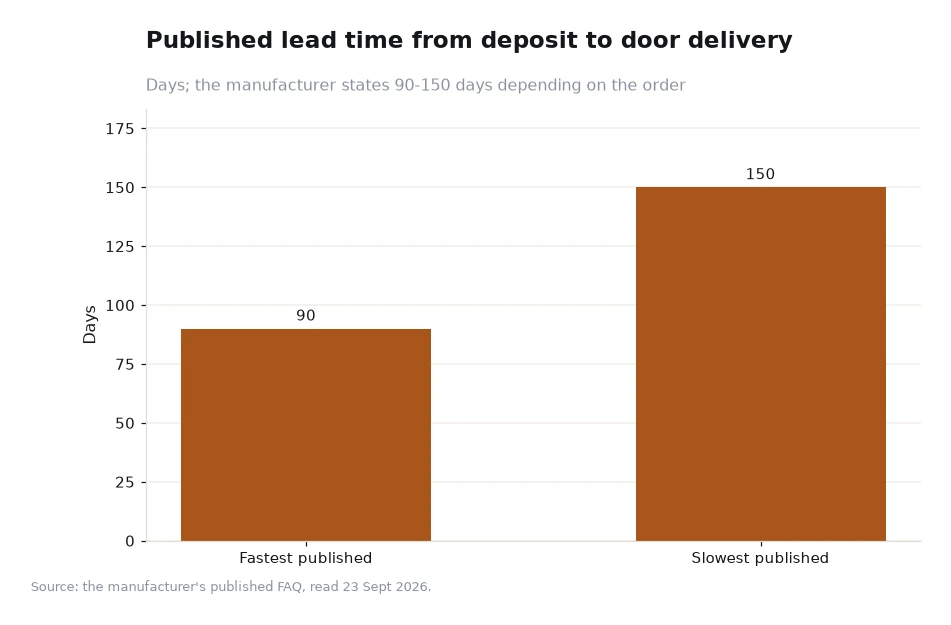
- Plan the opening on the published window of 90 to 150 days from deposit to door delivery, and pour foundations in that window rather than during it.
Start with the beer that pays the bills
Take last year's sales if you already trade, or a realistic forecast if you do not, and rank the beers by volume rather than by how interesting they are. In most small breweries one beer carries 50 to 70 per cent of the litres sold, a second carries a chunk, and the rest is rotation and seasonals. The core beer is the one that must never run out, so it is the one that sets the rhythm of the plant.
Convert its annual demand into a weekly figure and keep it in front of you while you read the rest of this article. A beer selling 480 litres a week is a very different project from one selling 4,800 litres a week, even though both can be brewed on equipment of the same design.
From weekly demand to brew length
Batch size should be small enough that the beer is fresh when it is sold and large enough that brew day labour is not a permanent cost. As a rule of thumb, a beer that turns over in two to four weeks in your cold room suits a batch that covers one to two weeks of its demand. Shorter than that and you spend your life cleaning; much longer and you are storing beer rather than selling it.
Because the batch is normally the volume of one fermentation vessel, the brew length and the tank size are the same decision. This is where the published range helps: 300 L and 500 L microbrewery kits for taproom-led breweries, 1,000 L brewhouses in two, three or four-vessel form for small production plants, 2,000 L and 2,500 L builds for sites with a distribution round, and 3,000 L to 10,000 L systems once wholesale volumes dominate. Match the class to your two-week core demand rather than to your ambition.
Turns per day: the number that decides vessel count
A brewhouse is not batching continuously. A brew takes a fixed sequence of hours: mash, lautering, boil, whirlpool, knock-out and cleaning. On a two-vessel set where the kettle doubles as the whirlpool, four to five hours per brew is a normal day, and the vessel can be turned twice if you mash in the second batch while the first is lautering. Adding a dedicated mash tun or a separate whirlpool is what lets a site run three or four brews a day without staff working around the clock.
So the question is not how big the kettle is, but how many brews a day your sales justify and how many hours a day you are willing to staff. A brewery selling 480 litres a week of core beer does not need two brews a day; it needs a reliable two-week rhythm. A brewery selling 4,800 litres a week needs either a bigger kettle or more brews, and the arithmetic that decides between those two options is the same arithmetic that decides your tank count.
| Configuration | Brews per day in practice | What it buys you | Fits which demand |
|---|---|---|---|
| Two-vessel, kettle and whirlpool combined | One, or two with staggered mashing | Lowest equipment cost, simplest floor plan | Taproom-led sales up to about 500 L a week |
| Three-vessel with separate mash tun | Two to three | Overlapping brews without waiting for the mash tun | Small wholesale round |
| Four-vessel with dedicated whirlpool | Three to four | Clean sequencing and shorter brew days | Production brewery with a distribution round |
| Larger multi-vessel systems | Scheduled across shifts | Volume at a planned rate, not at a hero rate | Regional supply |
Worked example: how many tanks for 24,000 litres a year
The assumptions are mine and are stated so you can replace them: the core beer sells 24,000 litres a year, spread evenly across 50 trading weeks; the brew length is 1,000 litres; 1 BBL is taken as about 117 L; fermentation runs 14 days and conditioning 7, so a tank cycle is 21 days; and 6 per cent is lost across transfers and packaging.
Step one, weekly demand: 24,000 L divided by 50 weeks is 480 L a week, which is 480 divided by 117, about 4.1 BBL a week. Step two, batches per year: 24,000 L divided by 1,000 L is 24 brews, so about one brew every two weeks. Step three, saleable beer from one brew: 1,000 L multiplied by 0.94 is 940 L, which is just under two weeks of sales, so a batch every two weeks holds the cold room steady.
Step four, tank turns: 365 days divided by a 21-day cycle is about 17.4 turns a year for one fermentation vessel. Step five, tanks needed: 24 batches divided by 17.4 turns is about 1.4 tanks, so two fermentation vessels cover the core beer with the second one taking up the slack when a batch runs long. That leaves the brewhouse idle for most of the year, which is exactly the headroom a seasonal or taproom-only beer needs. A 1,000 L brewhouse, then, is not undersized for this business; it is correctly sized, and the constraint sits in the tank farm rather than in the kettle.
Frequently asked questions
How do I decide the brew length for a new brewery?
Work back from the core beer's weekly sales: choose a batch that covers one to two weeks of that demand, then check that the batch size matches a fermentation tank size in the published range. A batch that covers two weeks of sales keeps beer fresh without turning the brewhouse into a daily cleaning job.
Does a two-vessel brewhouse limit how much I can brew?
It limits the pace rather than the volume. A two-vessel set where the kettle doubles as the whirlpool normally manages one brew a day, or two with staggered mashing, while three and four-vessel configurations allow two to four brews a day because mashing and whirlpooling no longer wait on each other.
Put the sales figure into the enquiry
When you approach a supplier, lead with litres per week for your core beer rather than with a vessel size you saw somewhere. The published hem craft beer equipment range is organised by brew length, so a supplier can map your demand onto one or two candidate sizes immediately and tell you which configurations are available at that size.
Useful supporting pages are the brewhouse listings for vessel counts and the About Us page for how the design work is run from business plan to brew. Between them you should be able to answer the only question that matters before you sign: does this plant make the beer I actually sell, at a pace my team can keep?
Published brew lengths, configurations, warranty terms and the delivery window come from the manufacturer's own website, read 23 Sept 2026; the weekly demand, batch counts and tank turns above are my own arithmetic from the stated assumptions.[1] Warranty cover runs 6 years on tank accessories and electronic components against manufacturing defects from the factory, used within scope.