Heat, Hills and Highways: Range in Australian Conditions
A published WLTP range of up to 525 km for the New G6 is a laboratory figure, and the manufacturer's own footnote says so: WLTP range depends on driving style, speed, passengers, load and temperature. Australian conditions push all five at once, which is why the useful question is not what the range is, but what it is on the road you drive.
Key takeaways
- WLTP range for the New G6 is published as up to 525 km, with conditions stated as a qualification.
- Up to 427 km of charge added in 15 minutes comes from internal tests of the G6 RWD Long Range.
- A 10-80% rapid charge is published at 12 minutes, so a stop adds range faster than a driver adds fatigue.
- Heat, hills and highway speed all move consumption in the same direction, so plan for the worst of them.
What a WLTP figure actually describes
The WLTP test is a standardised cycle run under controlled conditions, and it exists so that cars can be compared on equal terms rather than so that owners can expect the same number every day. The Australian pages are careful about this and attach the qualification that range depends on driving style, speed, passengers, load and temperature. Read the published up to 525 km for the New G6 as the best case in the standard cycle, and treat everything below it as normal rather than as a fault. Anyone cross-checking figures for a XPENG electric suv australia buyer will find the same qualification on the model page, so it is the manufacturer's caveat rather than a reviewer's caution.
Heat is a load, not a footnote
An Australian summer adds two penalties at once: the battery works harder in high ambient temperatures, and the cabin air conditioning draws real energy to pull a parked car down from a 50-degree interior. A car parked in the sun will spend its first ten minutes of running cooling itself, which is why the first short trip of a hot day looks worse per kilometre than the long drive afterwards. The practical adjustments are unglamorous: park in shade when you can, drop the windows for the first hundred metres instead of asking the air conditioning to do all the work at once, and expect the consumption figure to settle as the cabin stabilises.
Hills and load change the arithmetic
Gravity is not negotiable. Every metre of elevation gain has to be paid for with energy, and much of it comes back on the descent if the car can recuperate, which is why a hilly loop is far less expensive than a one-way climb to a plateau. Load behaves the same way in a simpler form: five adults and a boot full of luggage weigh more than a driver commuting alone, and the difference shows up on the consumption readout rather than in the specification sheet. If you regularly carry a full car, treat the published range as a ceiling and plan your stops from the consumption you actually observe, not from the figure you read before buying.
Highways, wind and the cost of speed
Speed is the largest single variable most drivers control. Aerodynamic drag rises with the square of speed and the energy required rises with the cube over time, so a 110 km/h highway cruise asks considerably more of the battery than an 80 km/h run on the same road. Add a headwind and a loaded roof or towbar and the picture moves further. This is where the published top-up figure earns its place: 10-80% state of charge in 12 minutes means a highway stop costs less time than a coffee queue, so the sensible strategy on a long run is to drive at a faster but honest pace and accept an extra stop rather than to crawl in the name of a number. The manufacturer's charging page sets out the connector and home-charging detail if you want the hardware side in the same place as the numbers.
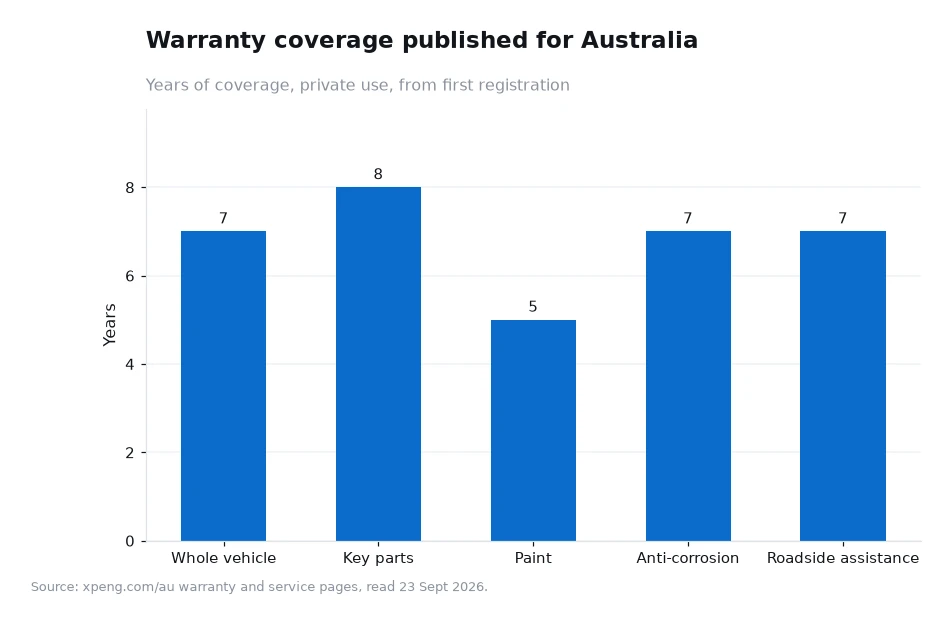
| Cover item | Years published |
|---|---|
| Whole vehicle, private use, unlimited km | 7 |
| Key parts, including traction battery | 8 years or 160,000 km |
| Paint, unlimited km | 5 |
| Anti-corrosion, unlimited km | 7 |
| Roadside assistance from first registration | 7 |
Cold mornings and coastal humidity
Heat gets the attention in Australia, but a frosty morning in the high country changes the picture in the other direction. Cold reduces the rate at which the battery can accept and release energy, so the first part of a winter drive is less efficient until the pack warms, and a pre-conditioning habit, where the cabin is warmed while the car is still plugged in, moves some of that cost to the grid instead of the battery. Coastal humidity is a different matter: the published protection includes IP67-rated charging hardware on the manufacturer's own high-power unit, and the everyday advice is simply to keep the charge flap and connector pins clean and dry before a session, which prevents most of the irritating faults owners report. None of this changes whether the car works. It changes how often you notice the difference between a mild day and an extreme one.
Worked example: cover in kilometres, and a trip in energy
Two illustrative calculations, both with assumptions stated, neither of them manufacturer data. First, cover: assume 15,000 km a year. Whole-vehicle cover is 7 years unlimited kilometres, so 7 x 15,000 = 105,000 km is driven inside it, with the calendar ending the term. Key parts cover is 8 years or 160,000 km, whichever comes first, and 8 x 15,000 = 120,000 km never reaches the cap, so that term also ends on the calendar. To hit 160,000 km inside 8 years you would need 160,000 / 8 = 20,000 km a year. Second, a trip: assume 18 kWh per 100 km under mixed conditions and a 600 km drive, so 6 x 18 = 108 kWh of energy. At $0.30 per kWh from home that is 108 x 0.30 = $32.40, and at an assumed $0.60 per kWh at a public rapid charger it is 108 x 0.60 = $64.80. Raise the assumption to 20 kWh per 100 km, a realistic hot-day figure with the air conditioning working, and the same trip needs 120 kWh instead of 108.
Frequently asked questions
Why does my range fall below the published WLTP figure?
Because WLTP is a standardised test cycle, and the manufacturer's footnote states that range depends on driving style, speed, passengers, load and temperature. Highway speeds, a hot day, a headwind and a full car all raise consumption, so a figure below the published maximum is expected behaviour rather than a fault.
How much range can a 15-minute rapid charge add?
The site publishes up to 427 km of charge added in 15 minutes, and its own footnote attributes that figure to internal tests of the G6 RWD Long Range. A separate published figure states that a 10-80% state-of-charge charge takes 12 minutes. Both depend on the charger and conditions.
How to plan a long drive without guessing
Drive the car on a normal week first and note the consumption it settles at in your own conditions, then plan stops from that number rather than from the brochure. On the day, charge where the stops suit you instead of chasing the last few per cent, because the published 10-80% window is the fast part and the final top-up is the slow one. Carry the cable, keep the roadside number saved, and treat the first long trip as a learning run rather than a test of the specification. If you need three rows for the same journey, the X9 model page lists its own published range and charging figures for comparison.
Range, charge-time and warranty figures quoted here are as published on the manufacturer's Australian pages and read on 23 Sept 2026, including the internal-test footnote for the 427 km figure. The kilometre and energy sums in the worked example are my own illustrative arithmetic with the assumptions stated, not manufacturer data. [1]