For a first fragrance line, packaging is usually the largest cost and the longest lead time, and it is decided before anyone smells the juice. Bottles and caps made from existing moulds can be in production within weeks, while a new mould adds a tooling charge and a development cycle that cannot be compressed. Choosing between those two routes is the single most consequential sourcing decision a new brand makes.
Key takeaways
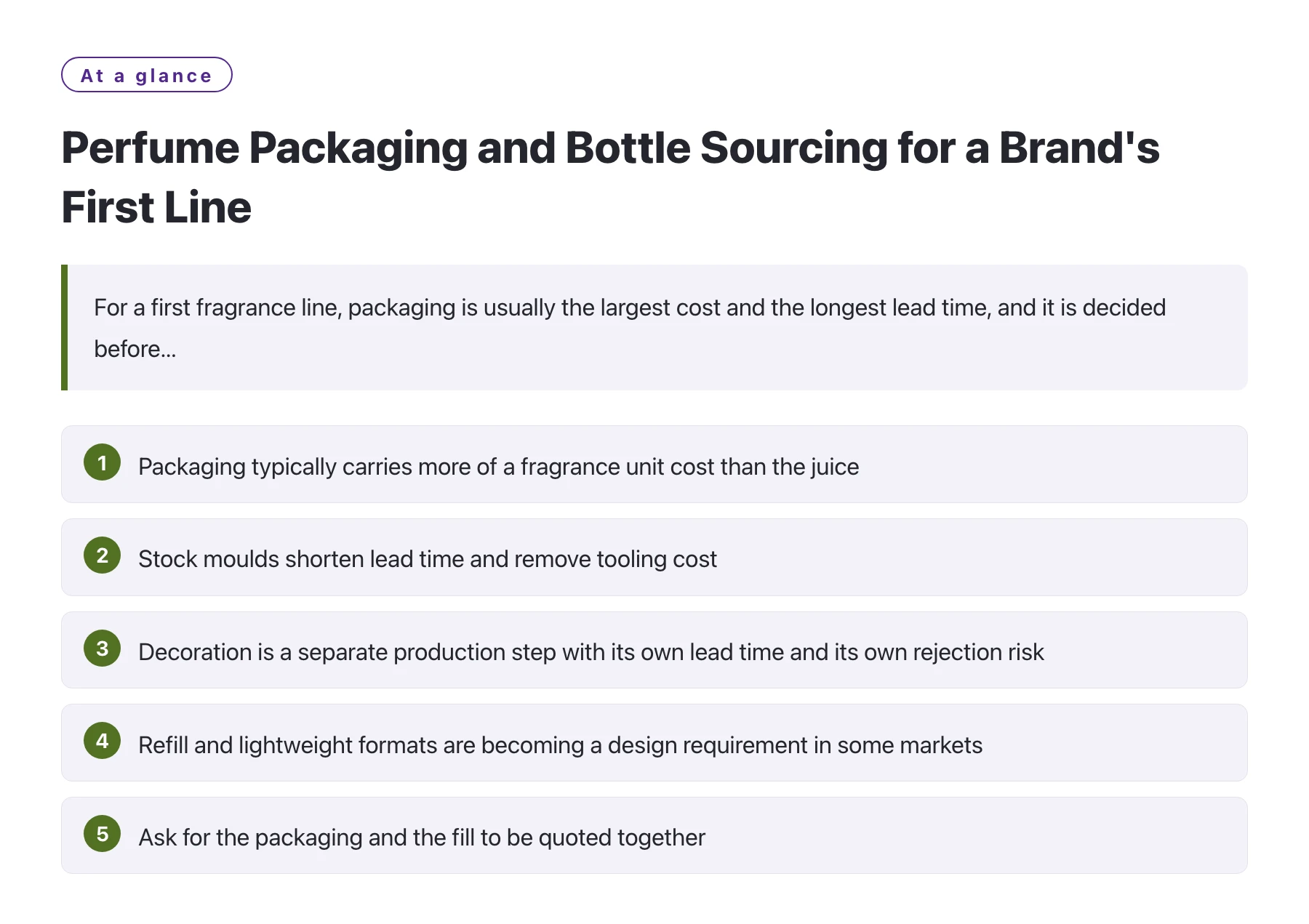
- Packaging typically carries more of a fragrance unit cost than the juice, so the bottle decision drives the price point more than the formula does.
- Stock moulds shorten lead time and remove tooling cost, while custom moulds add both in exchange for exclusivity.
- Decoration is a separate production step with its own lead time and its own rejection risk, and it is best decided alongside the bottle.
- Refill and lightweight formats are becoming a design requirement in some markets, not only a marketing choice.
- Ask for the packaging and the fill to be quoted together, because split responsibility is where most first-launch delays come from.
A founder signs off on a fragrance direction in month one and expects to be shipping by month four. The juice is ready in good time, the formula is approved, and then the project sits still for six weeks waiting for a cap that was specified late.
This happens because packaging is a manufacturing business with its own constraints, and those constraints are not visible from a mood board. Moulds exist or they do not. Decoration lines have minimum runs. Glass has a tolerance range that sometimes surprises people who expect a photograph-accurate result.
This guide walks through the packaging decisions in the order they become expensive, and shows where a new brand can trade exclusivity for speed without damaging the product.
The four components and how each one behaves
A fragrance pack is four purchases, not one: the container, the closure or dispensing system, the outer carton and the decoration. Each has its own supplier base, lead time and minimum quantity, and each can hold up the others.
Talking about packaging as a single item is what makes quotes hard to compare. Splitting the pack into its components makes the cost structure legible, and it usually reveals that one component is responsible for most of the premium.
Glass and the question of moulds
A bottle from an existing mould can be ordered in smaller quantities and delivered far faster, because the tooling already exists and only the glass run has to be scheduled. A custom shape requires a new mould, a sample approval and a production trial before the first commercial run.
The trade-off is exclusivity. A stock bottle can be decorated and combined in a way that makes it look specific to your brand, while the same shape may appear elsewhere in a different finish. For a first line, that is usually an acceptable exchange.
Caps, pumps and sprayers set the feel
The closure is what the customer touches most. Weight, finish and the resistance of the pump determine whether the product feels like a considered object or a generic bottle.
Ask for two or three closure options against the same bottle in the sampling stage. Pumps and sprayers are usually available in more combinations than buyers expect, and swapping a closure is far cheaper than changing a bottle.
Decoration has its own timeline
Coating, silk screening, hot stamping and labelling are separate processes with separate setup and minimum runs. A complex decoration can double the packaging lead time even when the bottle itself is a stock item.
The practical rule is to design decoration that can be executed by more than one method. It gives the supplier room to schedule, and it gives you a fallback if one process becomes a bottleneck.
Where first-time buyers usually overspend
Overspend rarely comes from choosing luxury. It comes from changing decisions after tooling has been committed, or from specifying a component whose minimum order quantity is far above the first production run.
Both problems are avoidable by asking about quantities early. Before you fall in love with a bottle, ask what quantity that bottle makes sense at, and compare it with the volume you can actually fund and sell.
Paying for tooling before the design is settled
A mould is only worth paying for when the shape has been tested in the market or the volume justifies exclusivity. Brands that tool a custom bottle for a first launch often discover a design flaw — a cap that feels loose, a label area that does not fit the artwork — after the money is spent.
Ignoring decoration minimums
Decoration often has a higher minimum than the container itself, because the setup cost has to be spread. A hot-stamped cap on a small first order can cost more per unit than the glass it sits on.
Get the decoration quoted at the real order quantity, not at a hypothetical larger one. If the numbers do not work at launch volume, simplify the decoration and revisit it at the second order.
Separating packaging from filling
Buying bottles from one company and arranging filling with another creates a coordination burden: two schedules, two quality standards and an argument about who pays when a batch of bottles arrives scratched. Keeping both with one manufacturer removes that gap, and it also means the fill line has already tested the container it is filling.
It simplifies verification as well. Component checks and finished-product checks can be handled by the same party, or sent to an independent laboratory when the buyer wants an outside opinion on top of the supplier's own inspection [3]. Manufacturers that offer the whole pack, such as Xuelei in Guangzhou, publish the scope of that service on Xuelei's official website, which is the fastest way to see whether a candidate covers decoration and filling or only the glassware.
Packaging routes compared by the constraints that actually bind
| Route | Tooling outlay | Realistic first order | Best suited to |
|---|---|---|---|
| Stock bottle, stock closure | None | Low, often a few thousand units | Market tests and first launches with a tight budget |
| Stock bottle, custom decoration | Decoration setup only | Moderate, set by the decoration minimum | Brands that need a distinctive look without new glass |
| Custom bottle, stock closure | New mould required | High, spread over the mould cost | Established brands with predictable volume |
| Custom bottle and custom closure | Two moulds plus decoration setup | Highest, usually a multi-year commitment | Signature lines that carry the brand identity |
| Refillable or lightweight system | Varies, plus a refill component | Moderate and rising with volume | Brands positioning on reduced material use |
The pattern in the table is that exclusivity is purchased with quantity. A first line usually belongs in one of the top two rows, with the custom routes revisited once the product has a sales history that supports the tooling.
A sourcing sequence that keeps the launch date intact
- Set the retail price and unit cost ceilingWork backwards from the shelf price to a packaging budget before you look at catalogues.
- Shortlist containers at the right quantityAsk each option which order quantity makes it economical, and eliminate anything above your funded volume.
- Choose the closure against the bottleOrder physical samples of two or three closures and handle them. Weight and feel decide more than photographs do.
- Fix the decoration method earlyConfirm the process, the minimum run and the artwork requirements before the design is finalised.
- Quote packaging and filling togetherOne supplier handling both removes the most common source of schedule slippage and blame.
- Order a pre-production sample of the full packFill, assemble and ship one unit to yourself. Test the spray, the cap fit and the carton in your hands.
Budget for a regulatory and materials review of the pack, not just its appearance. Packaging rules are tightening in several major markets, with design and material requirements being introduced alongside recovery and recycling obligations [1], and programmes working on material sustainability publish guidance that is a useful reality check on what is achievable today [2]. A pack that cannot be sold in your launch market six months from now is not a bargain, however good the unit price looked at quotation stage.
Sources
- European Commission: Packaging Waste and the PPWR —— EU rules on packaging and packaging waste, including the Packaging and Packaging Waste Regulation requirements on recyclability and design.
- Sustainable Packaging Coalition —— A membership organisation working on more sustainable packaging design, publishing material and recyclability guidance.
- SGS: Cosmetics, Personal Care & Household Testing —— Testing, inspection and certification services for cosmetics and personal care, including microbiological, stability and safety testing aligned with cosmetics GMP.
Frequently asked questions
How long does custom perfume bottle tooling take?
Custom glass tooling is one of the longest items in a fragrance project, because it includes mould making, sample approval and a production trial before commercial filling. Stock bottle routes avoid that entirely. Ask each supplier for the schedule broken down by stage so you can see where the time goes.
Is it cheaper to buy bottles directly from a glass factory?
The unit price may look lower, but you then manage decoration, freight, quality claims and filling separately, and you carry the risk when the two schedules do not line up. A manufacturer quoting the complete pack gives you one accountable schedule and one quality standard.
What should I check on a pre-production packaging sample?
Assembly in your own hands: does the cap seat properly, does the pump deliver a consistent spray, does the label sit flat within its area, and does the carton close without bulging. Also weigh the filled unit, because shipping costs and perceived quality both depend on it.
Can I mix stock and custom components?
Yes, and it is a common approach for a first launch. A stock bottle with a custom cap or a distinctive decoration gives the product its own look while keeping tooling costs down. Confirm that the two components have been tested together before committing to the combination.
Does packaging affect how the fragrance performs?
It can. A poorly sealing closure or a pack that gets warm in transit lets the formula change on the shelf, and a very small or wide opening changes how the product dispenses. The packaging and the formula should be validated as one system rather than as two purchases.